
Summary
- Short answer: if nobody in your house takes baths, a walk-in shower is usually the better everyday choice. It’s easier to step into and easier to keep clean, and that matters more every year you stay in the house.
- Keep a tub if you bathe little kids, you really love a soak, or it’s the only tub in the house and you plan to sell soon.
- Safety matters here: the CDC estimated about 234,000 nonfatal bathroom injuries in one year, 81% from falls, with the highest rates in or around the tub or shower.
- Cost: a typical Bath Fitter tub-to-shower conversion runs $8,500–$15,000. Seats, grab bars and glass doors push toward the top.
- You don’t have to choose for the whole house. Many families convert the main bathroom and keep a tub in the hall bath.
In this guide
Expert contributor: Aaron Bishop, Operations Manager for Columbia and Augusta. His quotes come from interviews on our Bath Fitter Fam podcast.
This might be the question we hear most at kitchen tables across our seven markets, from Greenville to Memphis to Oklahoma City: “Should we get rid of the tub?” The Mullikin family has been running Bath Fitter offices since 2003, and we’ve helped thousands of families answer it. Plenty of them went with a walk-in shower. Plenty of them kept a tub. A few found out they needed a plumber before they needed either one of us.
Maybe you haven’t taken a bath in years, and that tub is basically a very expensive place to hang the shower curtain. Or maybe climbing over the side has started to feel a little risky, for you or for someone you love, and you’re wondering if a shower is really the safer bet or if that’s just a sales pitch.
We hear you. This is a big decision for one small room, and you deserve a straight answer, including when the answer is “keep the tub.”
Below, we’ll walk through the real differences, when each one wins, what it does to resale, how safe each one actually is, what it costs, and a few simple questions that make the choice a lot easier.
What’s the real difference between a walk-in shower and a bathtub?
Most homes have a standard tub-shower combo: a tub with a showerhead above it. To shower, you step over the side of the tub, which is usually well over a foot tall, and stand on a curved, slippery surface.
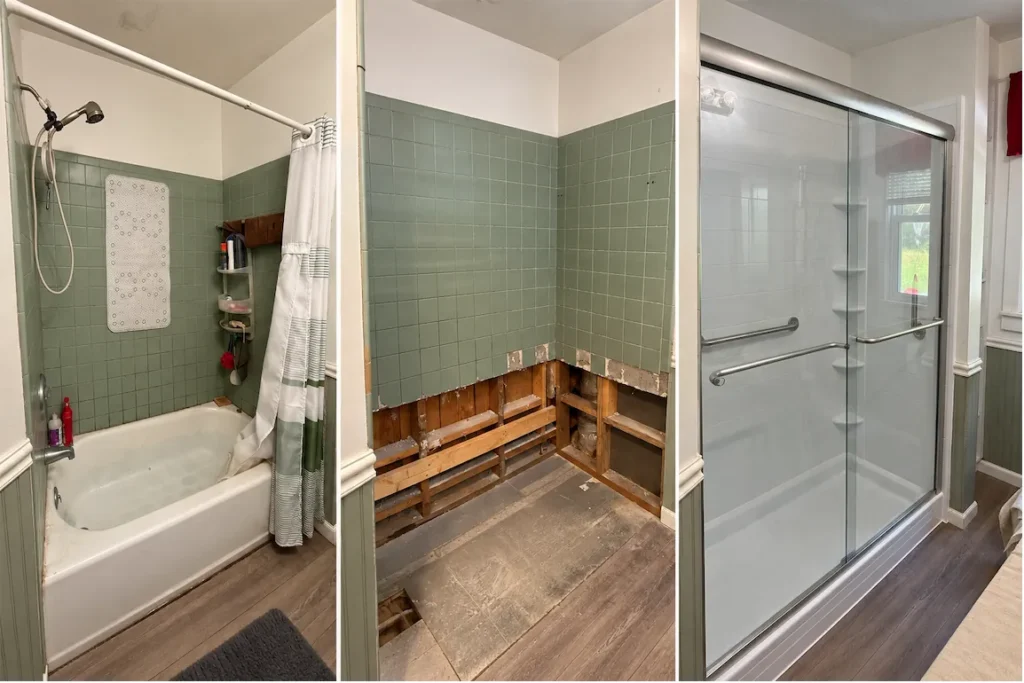
A walk-in shower replaces all of that with a shower base that has a low threshold at the front. You step in instead of climbing in. In a tub-to-shower conversion, the new shower usually goes right into the space the tub used to take up, so the plumbing stays roughly where it was and the rest of your bathroom doesn’t have to change.
Here’s what makes a Bath Fitter conversion different from most. Bath Fitter manufactures every shower base and wall our local crews install, and each one is custom-fit to the exact space your tub is in now. The wall goes in as one piece, so there are no grout lines to scrub and no tile seams for water to sneak behind. That’s a big part of why most of the rest of your bathroom can stay just the way it is. If you’re curious how acrylic holds up, we cover the honest pros and cons in our guide to acrylic shower walls.
How low is “low threshold”? Our shower bases have a step-in of about 3 or 6 inches, roughly the height of your phone standing on end. Pulling out an old fiberglass tub surround often gives you room back, too. Those units have built-in ledges and jut-outs, and a lot of homeowners are surprised how much space they actually had.
That’s really the whole trade. A tub gives you the option to soak. A walk-in shower gives you an easier way in and out, every single day.
When is a walk-in shower the better choice?
- Nobody in the house takes baths. This is the big one. If your tub gets used for showers only, you’re climbing over a wall every day for a feature you don’t use.
- Getting in and out is getting harder. Bad knees, a new hip, balance that isn’t what it used to be, or a parent moving in. A low threshold plus a seat and grab bars can be the difference between showering on your own and needing help.
- You want easier cleaning. A flat shower base and one-piece walls are a lot less work than scrubbing around the curve of a tub.
- Your bathroom feels cramped. A glass door on a walk-in shower opens up the room visually in a way a shower curtain on a tub never will.
Robert F. said it better than we ever could in his review this fall:
“8 hours and 45 minutes changed my Life. I will no longer step over the side of a tub to take a shower. No more suction cup grab bars (the ones that come loose). Stan at Bathfitters Duncan was laser focused and literally had a laser tape measure.”
Robert F. · Greenville, SC · Google review, 2026
That’s the stuff that makes this job worth doing.
When should you keep your bathtub?
Here’s where we’ll talk you out of a sale if we need to.
If you bathe little kids, keep a tub somewhere in the house. Bathing a toddler in a walk-in shower can be done. Ask any parent who’s tried it how much fun it was. If you’ve got young kids or grandkids who stay over a lot, you’ll want that tub.
If a hot bath is how you unwind, or your doctor has you soaking sore joints, don’t give that up because a trend says so.
And if it’s the only tub in the house and you plan to sell soon, slow down and read the next section before you decide anything.
And here’s the thing a lot of people don’t realize: you don’t have to pick one for the whole house. Plenty of families convert the main bathroom to a walk-in shower and keep a tub in the hall bath. Curtis P. in Oklahoma City did exactly that:
“The next two days Chase and Jacob (installers) installed the new shower floor and walls. We are very pleased with their work and the look of the new shower. Chase and Jacob also installed a tub liner in our second bathroom and it looks great also.”
Curtis P. · Oklahoma City market · Google review, 2023
New shower where they needed it, a refreshed tub where they wanted to keep one. That’s usually the smartest answer for a multi-bathroom home.
Will removing your bathtub hurt your home’s resale value?
It depends, and anyone who gives you a flat yes or no is guessing.
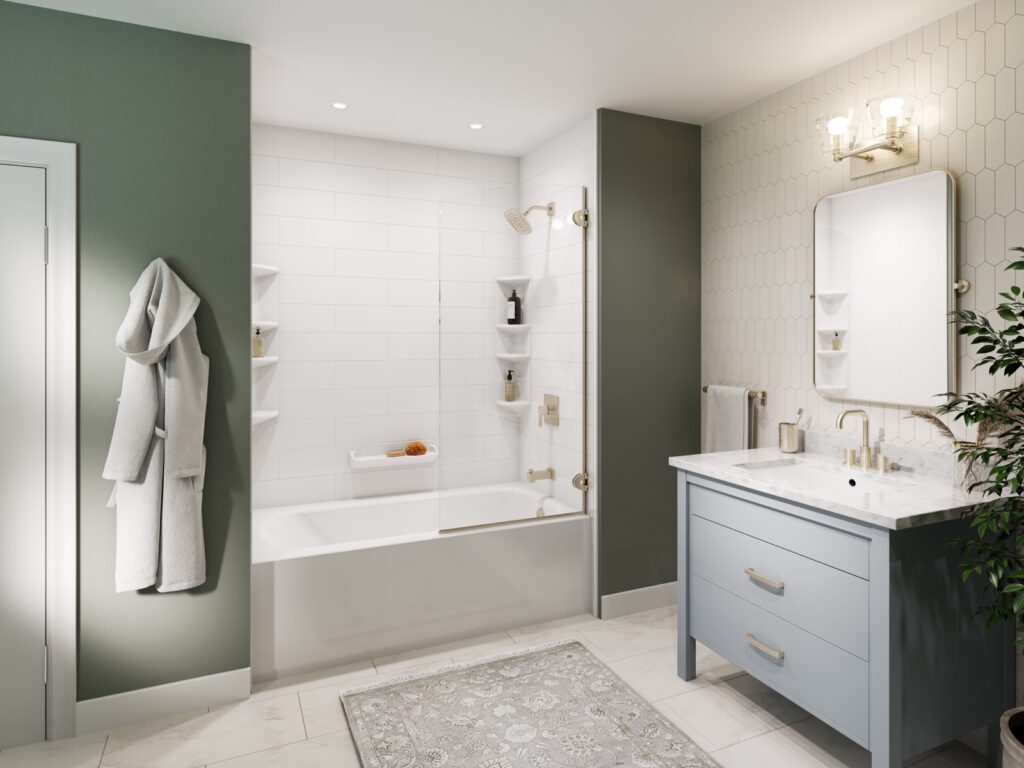
The rule of thumb most real estate agents use is simple: keep at least one tub in the house. Families with young kids are a big slice of home buyers, and some of them will pass on a house with no tub at all. If you have two or more bathrooms and one of them keeps a tub, converting the other is rarely a problem, and an updated walk-in shower in the main bathroom often reads as a plus.
Aaron Bishop, who runs our Columbia and Augusta operations, used to hold a real estate license. His take is that a dated bathroom hurts more than a missing tub does. When buyers walk into a bathroom that’s been completely redone, they read it as “everything here has been updated,” whether it has a tub or a shower. And if you’re not selling? “If this is your forever home, get what you want.”
Where it flips: if you live in an area popular with retirees, or your home is a one-story that appeals to buyers planning to age in place, a walk-in shower can be exactly what those buyers are looking for.
If you’re planning to sell in the next year or two, it’s worth a five-minute call to a local agent before you decide. If you’re planning to stay, make the bathroom work for the people who live there now. You’re the one showering in it every day.
Is a walk-in shower safer than a bathtub?
For most people, especially as we get older, yes. But it isn’t magic, and we won’t pretend it is.
The numbers are sobering. In its national study of 2008 data, the CDC estimated about 234,000 nonfatal bathroom injuries among adults in a single year, and 81% of them were caused by falls. The highest injury rates happened in or around the tub or shower, and the risk climbs sharply with age. More broadly, the CDC says more than one in four older adults falls each year.
Stepping over a tub wall on a wet foot is one of the riskiest moves most people make all day. A low threshold takes that step away.
What a walk-in shower doesn’t do is make a wet floor dry. The CDC’s own advice is simple: grab bars inside and outside the tub or shower, and non-slip strips on the floor. From what we see in homes every week, two more things help: grab bars mounted into the wall instead of suction cups, and a seat if standing for a whole shower is tough. John P. got both:
“He took out the existing bathtub and installed a walk-in shower with grab bars and seat and did a beautiful job.”
John P. · Upstate SC/Western NC market · Google review, 2026
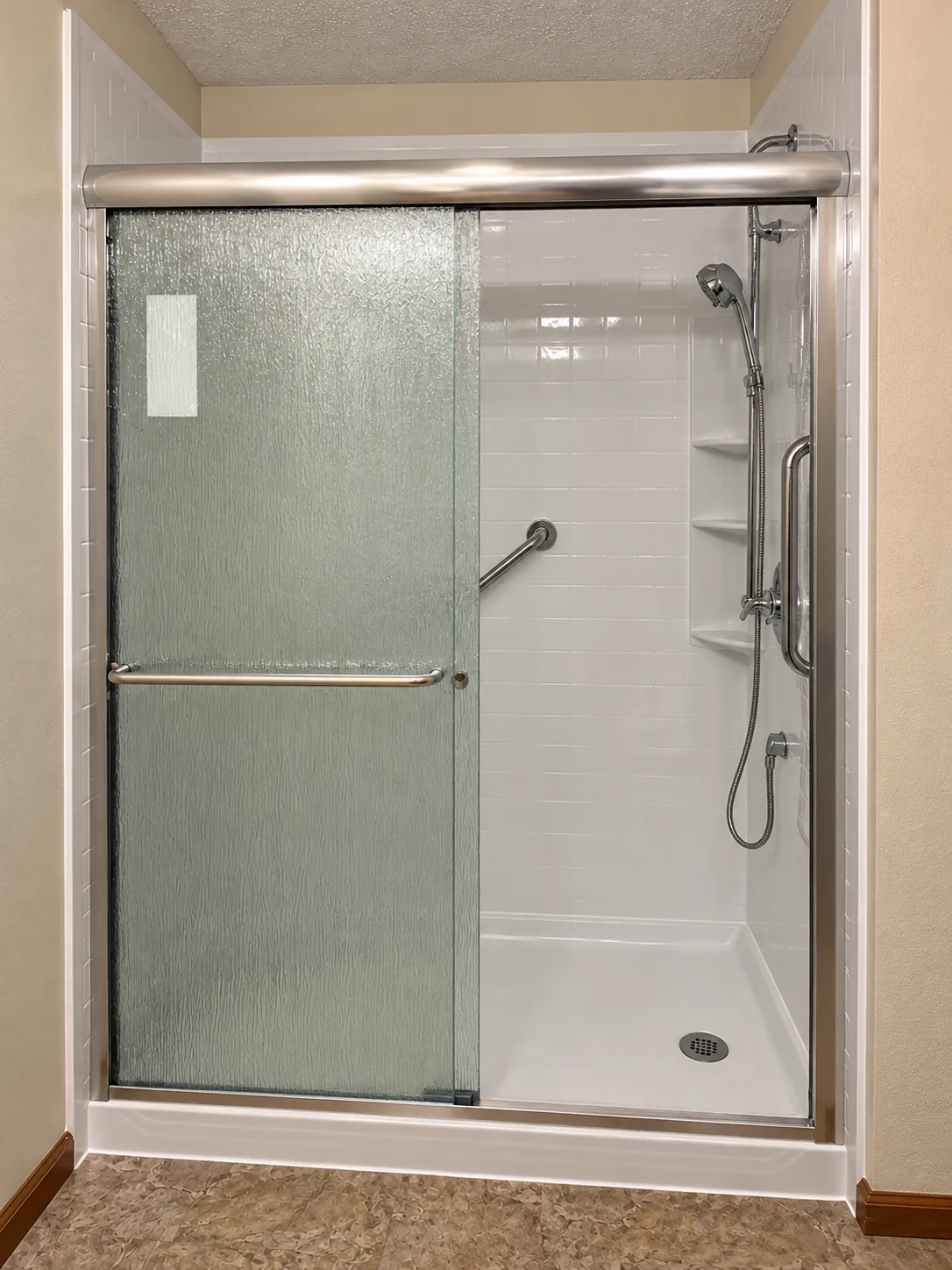
A handheld showerhead on a slide bar, like the one above, is a small add-on that makes a big difference if you shower seated.
And if you want to keep your tub, you can still make it safer. Grab bars can go into a tub surround too. Ask us.
How much does a walk-in shower cost compared to keeping a tub?
| Option | Typical cost | Time in your home | Best for | Watch out for |
|---|---|---|---|---|
| Keep the tub, add grab bars | The lowest-cost safety upgrade; ask for a quote | Usually a short visit | People who still use the tub and just want more support | You’re still stepping over the tub wall |
| Bath Fitter tub and walls over your existing tub | Priced at your free in-home consultation | As little as one day | Families who want to keep a tub but want it to look and clean like new | Doesn’t lower the step-in height |
| Bath Fitter tub-to-shower conversion | $8,500–$15,000; about 70% of customers land in the middle | As little as one day; some projects take longer | Anyone who doesn’t use the tub, or wants an easier, safer way in | Keep a tub elsewhere if you have young kids or plan to sell soon |
| Custom tile walk-in shower (full remodel) | About $16,000 to $19,000 for the shower area of a roughly $26,000 national mid-range remodel | Often one to three weeks | People renovating the whole bathroom who want real tile or stone | Grout to clean and reseal, and a longer torn-up bathroom |
On a conversion, the things that move the price are the things you pick: a glass door instead of a curtain, a seat, grab bars, shelving, and hardware finish. Simple, classic choices land toward the low end. The full breakdown is in our Bath Fitter cost guide.
Is a walk-in tub better than a walk-in shower?
If you want both a low step-in and the ability to soak, a walk-in tub is the product built for that. They have a door in the side and a built-in seat.
They’re a good fit for some people. The trade-offs worth knowing: you have to sit inside while the tub fills and while it drains, they tend to cost a good bit more than a shower conversion, and they take up the full tub footprint. We don’t install walk-in tubs, so if that’s what you’re after, we’re not your people, and that’s okay. Get a couple of quotes from companies that specialize in them.
How long does a tub-to-shower conversion take?
A lot less time than most people expect. Our installations can take as little as one day, and some projects take longer, usually when we find something behind the old tub that needs fixing first. Sometimes that “something” is hiding in the plumbing:
“Mike was honest in showing that the cast iron p trap had severe build up inside and he replaced it… all part of the job at no additional cost to us.”
JohnMoD · Upstate SC/Western NC market · Google review, 2026
That’s the kind of thing we’d rather fix while we’re in there than leave for you to find later.
Compare that to a traditional tile remodel, where you’re often looking at one to three weeks without that bathroom.
How do you decide between a walk-in shower and a tub?
Ask yourself these five questions:
- When was the last time anyone in this house took a bath in this tub?
- Is getting in and out getting harder for anyone who uses this bathroom, or likely to in the next five years?
- Is there another tub in the house?
- Are you planning to sell in the next year or two?
- Do you bathe young kids or grandkids here?
If the answers are “ages ago,” “yes,” “yes,” “no,” and “no,” a walk-in shower is almost certainly the right call. If you answered “last night” to the first one, keep that tub and enjoy it.
Should you choose a walk-in shower or a bathtub?
Choose the one that fits the people who actually live in your house. For most homeowners who shower every day and rarely bathe, that’s a walk-in shower. For families with little ones, people who love a soak, or a one-tub house headed for the market, keeping a tub makes more sense. And in a lot of homes, the best answer is one of each.
Every Bath Fitter tub and shower comes with a lifetime warranty, and our design consultants are happy to talk through both options with you, no pressure either way.
Whatever you decide, make sure whoever you hire does what they say they’re going to do.
We’d love to help you figure it out. See our published pricing, explore Tub to Shower Conversion, or get an Instant Estimate whenever you’re ready.
Sources
Frequently asked questions
Can you add a seat to a walk-in shower?
Yes. A seat is a common add-on for a tub-to-shower conversion, along with grab bars and shelving. Each one moves the price up a bit.
Is a walk-in shower easier to clean than a tub?
Yes. There's no curved tub floor to scrub around, and one-piece walls mean no grout lines. A soft cloth and an approved cleaner handle most of it.
Do walk-in showers need a glass door?
No. You can choose a glass door or a shower curtain. Glass looks more open and keeps water in better. A curtain keeps the cost down.
Will I lose storage if I remove my tub?
Usually you gain some. Built-in shelving can be added to a conversion, and a lot of people find it beats the tub ledge they had before.
Is a tub-to-shower conversion covered by Bath Fitter's lifetime warranty?
Yes. Every Bath Fitter tub and shower comes with a lifetime warranty. The warranty page has the full details.
This guide applies to: Bath Fitter Augusta, Bath Fitter Columbia, Bath Fitter Little Rock, Bath Fitter Memphis, Bath Fitter Oklahoma City, Bath Fitter Tri Cities, Bath Fitter Upstate SC/Western NC.