
Summary
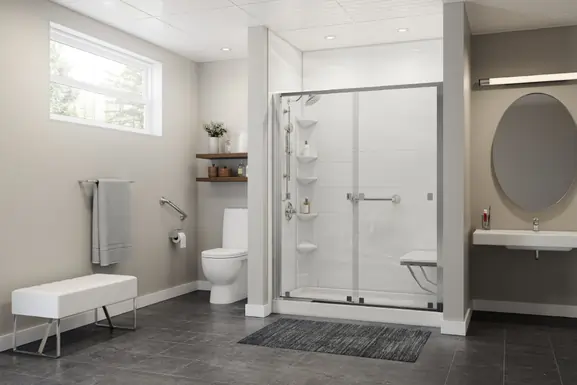
- A safe shower for aging in place comes down to four things: a low step-in, grab bars anchored where your hands reach, a place to sit, and a handheld showerhead.
- Our shower bases step in at about 3 or 6 inches, compared with a tub wall that's usually well over a foot.
- Seat options: a flip-down acrylic seat, a corner-molded seat, or a movable mesh chair that keeps you closer to the controls and leaves room for a caregiver.
- If someone uses a wheelchair, you need a roll-in shower. If the whole room needs rebuilding, call a CAPS-certified general contractor.
In this guide
Expert contributors: Aaron Bishop, Operations Manager for Columbia and Augusta, and Kell Chapman, Operations Manager for the Upstate SC and Western NC. Their quotes come from interviews on our Bath Fitter Fam podcast.
Most people never think about how they get into the shower. Until one day they do. A new hip, a bad knee, a parent moving in, a fall that was almost a bad one. William Mullikin put it simply on our podcast: a lot of people take it for granted, being able to bathe themselves alone.
It’s one of the most common reasons people call us. Since Louie Mullikin opened our family’s first Bath Fitter office in 2003, we’ve set up showers for aging in place in homes across all seven of our markets, from Greenville to Memphis to Oklahoma City. And we’ll be straight with you: sometimes the right answer is a simple grab bar, sometimes it’s a full roll-in shower, and sometimes it’s a conversation with an occupational therapist before anybody calls us.
Maybe you’re shopping for yourself and don’t love admitting it’s time. Or maybe you’re the son or daughter who lies awake wondering whether Mom is going to slip getting over that tub wall.
We hear you, on both counts. Wanting to stay independent in your own home is about as normal as it gets, and so is worrying about someone you love.
Below, we’ll cover what makes a shower safe, how low the step-in should be, where grab bars go, which seat fits whom, and what caregivers need, all without your bathroom looking like a hospital.
What makes a shower safe for aging in place?
Most home-safety checklists come back to the same four things, no matter who installs the shower:
- A low step-in. One of the riskiest moves in most bathrooms is lifting a wet foot over a tub wall.
- Something solid to hold. Grab bars anchored into the wall, where your hands naturally go.
- A place to sit. Standing for a whole shower gets harder long before most people say so out loud.
- Water you can reach. A handheld showerhead, so you aren’t twisting under a fixed head.
Falls are the reason this matters. The CDC counts about 4.5 million emergency department visits a year from falls among older adults, and earlier CDC research found the highest bathroom injury rates happen in or around the tub or shower. Every one of the four things above is about taking a risky moment out of the routine.
How low should a shower threshold be?
Lower is easier, but there’s a trade-off. A completely flat, curbless entry is great for a wheelchair, and it takes more work to keep water in. For most people who walk in, a low curb is the sweet spot.
Our standard shower bases have a step-in of about 3 or 6 inches. Compare that to a typical tub wall, which is usually well over a foot. Kell Chapman, who runs our installs across the Upstate and Western North Carolina, has a quick way to tell whether a low threshold is what you need:
“If you can get your foot into your shoe by yourself… if you can get into a car, things like that. If you’re struggling with any of those things, the low threshold is probably what you’re shopping for.”
Kell Chapman · Operations Manager, Upstate SC and Western NC
Aaron Bishop, who runs our Columbia and Augusta teams, says the real difference is that you stop negotiating with your own body every morning. With a tub, it’s “is my knee gonna work with me today or not?” With a low threshold, you just step in.
Where should grab bars go in a shower?
Where your hands actually reach when you step in, turn around, sit down and stand back up. That’s different for every person, which is why a good installer asks before drilling.
A few general rules hold up almost everywhere. Put one near the entry so you have something to hold while you step in. Put one on the wall where you’ll turn to face the water. And if there’s a seat, put one within reach of it so you can push up to stand. Grab bars need to be anchored into the wall, never held on by suction cups or a towel bar pretending to be one.
Kell remembers one customer who ended up with six grab bars in a single shower, including a couple stacked on the back wall. “Is she the safest shower user in the whole county? Probably.” Our goal is to work with you to get exactly what you need.
That kind of patience shows up in our reviews, too. From a homeowner in our Memphis market:
“Our installer was very patient with us as we decided where we wanted grab bars, etc. placed in our shower.”
Brooks P. · Memphis market · Google review, 2025
The good news is you don’t have to get it perfect on day one. Aaron says most people don’t know what they need until they’ve used the shower for a while:
“You might say, oh, this [is] the perfect design… We put it in there, and you’re like, man, a grab bar right here would just be ideal. Okay, we’ll see you next Tuesday. It’ll take us 45 minutes.”
Aaron Bishop · Operations Manager, Columbia and Augusta
Shirley H., also in Memphis, called us back for exactly that: “A small job… added a grab bar… but treated it like a most important job.”
Which shower seat is best?
The right seat depends on who’s using it, how often, and whether anyone else shares the shower. Here are the options we install and how they compare:
| Seat type | What it is | Best for | Watch out for |
|---|---|---|---|
| Flip-down acrylic seat | An acrylic seat on a metal bracket mounted and braced into the wall. It folds up flat when you don’t need it. The bracket matches your trim finish, so matte black trim means a matte black seat frame. | Showers shared by people with different needs, or anyone who wants the floor clear most of the time | It’s fixed in one spot, usually at the back of the shower |
| Corner-molded seat | A smaller acrylic seat built into a back corner of the shower | A permanent perch for shaving legs or resting, without anything to fold | Smaller than a flip-down seat, and it doesn’t move |
| Moen mesh shower chair | A freestanding chair with a mesh seat and removable arms | Trying out seated showers before committing, or anyone who needs to sit close to the controls | It takes up floor space and needs to be moved in and out |
Here’s the part people don’t think about. Most of our showers are about five feet long, and a built-in seat usually sits at the back. That puts you four and a half to five feet from the water controls. William points out that for someone who needs help in the shower, that isn’t always ideal. A movable chair lets you sit near the controls, and it gives a caregiver room to stand behind you.
Kell is a big fan of the mesh chair for that reason, and for comfort. If you’ve been perching on a hard plastic stool for 20 minutes, mesh feels like a recliner. And both the flip-down and corner seats can be added after your install, so starting with a chair and upgrading later is a perfectly good plan.
Why does a handheld showerhead matter so much?
Because the moment you sit down, a fixed showerhead is in the wrong place. A handheld on a slide bar lets you rinse while seated, aim the water away from a sore shoulder, and let a caregiver help without getting soaked.
Look for a long hose. Kell says our handheld hose can reach all the way to the back of the shower, which matters if your seat is back there. And ask about dual controls, so you can use the showerhead and the handheld together or switch between them without fiddling.
One more thing people don’t think about: cleaning gets harder too. Kneeling to scrub grout lines isn’t easy at 80. Our walls go in as one piece, with no grout lines to scrub, so keeping the shower clean doesn’t take a toothbrush and a bad back.
What should caregivers know about shower safety?
If you help someone bathe, the shower has to work for two people. That’s where tubs fall short. Aaron sees families doing their best with what they have all the time:
“They have a chair that fits halfway in the bathtub and it comes over the rail. Yeah, we see that all the time… It’s obviously not meant for that.”
Aaron Bishop · Operations Manager, Columbia and Augusta
A low-threshold shower lets a caregiver step in to help. A seat and grab bars give the person showering something to hold while you assist. And think about the opening. A wide entry, or a fixed glass panel in place of a door, gives you room to work and gives paramedics easier access in an emergency. Your design consultant can walk you through the options.
Aaron says this is the part of the job that sticks with him: “For some people, they need something reliable so their family member can come home… it’ll give you goosebumps thinking about it.”
From a homeowner in our Memphis market who set up a shower for her mother:
“Delivered what they promised but more than that is the peace of mind knowing my mom has a safe shower to get in and out.”
Edye J. · Memphis market · Google review, 2025
Can an accessible shower still look nice?
Yes. This is one of the biggest worries we hear, and Aaron hears it constantly:
“A lot of people hear ADA and they’re thinking, oh, I don’t want my bathroom looking like the hospital, right? And that is just not the case.”
Aaron Bishop · Operations Manager, Columbia and Augusta
Grab bars come in different lengths and finishes to match your fixtures. Shelves, soap dishes and towel bars are acrylic and color-matched to your walls. The walls themselves come in tile-look patterns, so a safe shower can look like a nicely updated one. Most guests will just think you remodeled.
Part of why it all looks like it belongs together is that it does. Bath Fitter makes the walls, the bases, the seats and the acrylic accessories, so the shelves and soap dishes come in the same color as your walls and the seat bracket matches your trim. And if anything ever needs attention, there’s one company to call.
When do you need a roll-in shower instead of a walk-in?
If someone in the home uses a wheelchair, or likely will soon, a walk-in shower with a curb isn’t enough. You need a roll-in: no curb, or a built ramp, and a base big enough to turn around in.
We build those, too, including ADA-style roll-ins for homes. They usually involve a custom floor system, and they’re one of the few jobs that typically take two days. (Our article on whether a shower can really be remodeled in one day explains why.)
When is Bath Fitter not the right fit for an accessible bathroom?
We’d rather tell you up front:
- You need the whole room rebuilt. Wider doorways, moving walls, a new layout for a wheelchair. That’s a job for a general contractor, ideally one who’s a Certified Aging-in-Place Specialist (CAPS). We focus on the tub and shower area.
- You’re not sure what’s needed yet. An occupational therapist can do a home safety visit and tell you exactly what will help. That’s worth doing before you spend money with anyone.
- You really want to keep soaking. A walk-in tub might fit you better. We don’t install those, and our walk-in shower vs. bathtub guide covers the trade-offs.
How do you start planning a safer shower?
Start with the person who’ll use it. Watch how they get in and out today, where they reach, and when they hesitate. Then let someone who does this every day help you match the setup to the person.
Every Bath Fitter tub and shower comes with a lifetime warranty, and seats and grab bars can be added later as needs change. If you’d like to see what yours would cost, get an Instant Estimate, or we can come out for a free in-home consultation, with whoever will be using the shower right there at the table.
Whatever you decide, make sure whoever you hire does what they say they’re going to do.
We’d love to help. See our published pricing or explore Tub to Shower Conversion whenever you’re ready.
Sources
Frequently asked questions
Do grab bars have to go into a stud?
They have to be anchored solidly into the wall structure, never held up by suction cups or drywall anchors alone. Your installer will find the right spots before drilling.
Will the grab bars and seat match my fixtures?
Yes. Grab bars come in finishes to match your trim, and the metal bracket on a flip-down seat matches your trim kit too.
Does an accessible shower take longer to install?
Usually not. A walk-in shower with a low curb, a seat and grab bars is typically installed in as little as one day. A roll-in shower with a custom floor system or a ramp is one of the few jobs that usually takes two days, and we'll tell you that at your consultation.
Is a flip-down shower seat strong enough to sit on every day?
Yes. It's mounted and braced into the wall for everyday use. Ask your design consultant about the weight rating for your setup.
Do I need an occupational therapist before remodeling for accessibility?
You don't have to, but a home safety visit from an OT is a smart first step if you're not sure what will help. Their recommendations make the design conversation easier.
This guide applies to: Bath Fitter Augusta, Bath Fitter Columbia, Bath Fitter Little Rock, Bath Fitter Memphis, Bath Fitter Oklahoma City, Bath Fitter Tri Cities, Bath Fitter Upstate SC/Western NC.