
Summary
- Water usually gets behind a tub through failed caulk, porous grout, a tub that settled or flexes, or a slow leak at the drain or valve.
- Warning signs: a soft floor in front of the tub, loose floor tiles, caulk that keeps failing, bubbling paint, a ceiling stain below or a musty smell.
- Fiberglass units and tile surrounds can hide years of damage with no visible signs.
- Most contractors treat rot found during demo as a change order. Ask about it before you sign.
- With Bath Fitter Fam, repairing rot or water damage in the wet area is included in your price.
- Foundation problems and main-line plumbing need a specialist first. We’ll tell you if that’s the case.
In this guide
Expert contributors: Aaron Bishop, Operations Manager for Columbia and Augusta, and Kell Chapman, Operations Manager for the Upstate SC and Western NC. Their quotes come from interviews on our Bath Fitter Fam podcast.
“What if you pull my tub out and the floor’s rotten?” We hear some version of that in a lot of living rooms. Aaron Bishop, who runs our Columbia and Augusta teams, put it plainly on our podcast:
“I think everybody’s biggest fear is that they’re going to tear my bathroom out and my joists are going to be completely gone.”
Aaron Bishop · Operations Manager, Columbia and Augusta
Since Louie Mullikin opened our family’s first Bath Fitter office in 2003, our teams across seven markets have pulled out thousands of old tubs and showers. Most of the time, what’s behind them is fine or close to it. Sometimes it isn’t. And once in a while, the problem is bigger than a bathroom job, and we’ll tell you to call someone else first.
Maybe you’ve noticed a soft spot in the floor right in front of the tub. Or the caulk along the tub keeps cracking no matter how many times you redo it, and you’re starting to wonder what’s going on underneath.
Here’s what we’ve learned. We’ll cover how water gets behind a tub, the warning signs you can check yourself, why some damage gives no warning at all, what usually happens when a contractor finds rot, how our family handles it, and when the damage is bigger than anything a bathroom company should fix.
How does water get behind a bathtub in the first place?
A bathtub sits in the wettest spot in your house, surrounded by materials that aren’t waterproof. The wall behind it is usually drywall or backer board over wood studs. The floor under it is usually plywood or boards over wood joists. The only things keeping water away from all that wood are a few seams and seals.
When one of those seams fails, water finds the wood. The most common paths we see:
- The caulk line where the tub meets the wall. Caulk shrinks, cracks and pulls away over time. Every shower after that sends a little water into the gap.
- Grout on tile walls. Grout is porous. If it isn’t sealed and maintained, water soaks through to whatever’s behind the tile.
- A tub that has settled or flexes. A heavy cast iron tub can sink slightly over the years. A thin fiberglass tub can flex every time someone steps in. Either one opens gaps that weren’t there on day one.
- Leaks inside the wall or under the tub. A worn drain or overflow gasket, or a slow drip at the valve, can leak for years where nobody can see it.
- Water on the floor. A curtain that doesn’t quite reach, or kids splashing over the side, puts water on the floor every day. If the floor seal at the tub is gone, it runs straight underneath.
None of these are dramatic. That’s the problem. A small leak that runs every day for ten years does a lot more damage than one big spill.
What are the warning signs of rot or water damage around a tub?
Some damage does show itself. Here’s what to look for, what it can mean and how fast you should act.
| What you notice | What it can mean | How soon to deal with it |
|---|---|---|
| Soft or spongy floor in front of the tub | The subfloor has been wet long enough to weaken | Soon. A soft floor only gets softer |
| Floor tiles at the tub that crack, loosen or sound hollow | Movement or moisture underneath | Soon |
| Caulk or grout at the tub line that keeps failing | The tub is moving, or water is already getting behind | Re-caulk now, and watch it. If it fails again quickly, have it looked at |
| Bubbling paint, soft drywall or a swollen baseboard near the tub | Water is traveling inside the wall | Soon |
| A stain on the ceiling of the room below | A leak from the drain, overflow or floor seal | Right away |
| A musty smell that doesn’t go away after cleaning | Mold growing somewhere you can’t see | Soon |
| A tub that creaks, rocks or feels like it gives when you step in | Weak support or a weakened floor under the tub | Soon, and be careful stepping in |
You can check most of these yourself in about ten minutes:
- Stand in front of the tub and press down with your heel at a few spots along the floor.
- Run a finger along the caulk line and press on the tiles closest to the tub.
- If the bathroom is upstairs, look at the ceiling directly below it.
- If there’s an access panel behind the tub plumbing (often in a hallway or closet), open it with a flashlight. Look for dark stains, damp wood or drips under the drain.
- Run the shower for a few minutes and watch where the water goes at the corners and the floor.
Can there be damage even when everything looks fine?
Yes, and this is the part most people don’t expect. Plenty of the worst damage we see comes out of bathrooms that looked perfectly normal.
One-piece fiberglass tub and shower units hide the most. They cover the whole wet area, so there’s nothing to see crack or stain. If one has been leaking at the drain or around the valve for years, there’s often no way to know how bad it is until it comes out. Tile surrounds can hide it too, because water can soak through grout and into the wall behind while the face of the tile still looks clean.
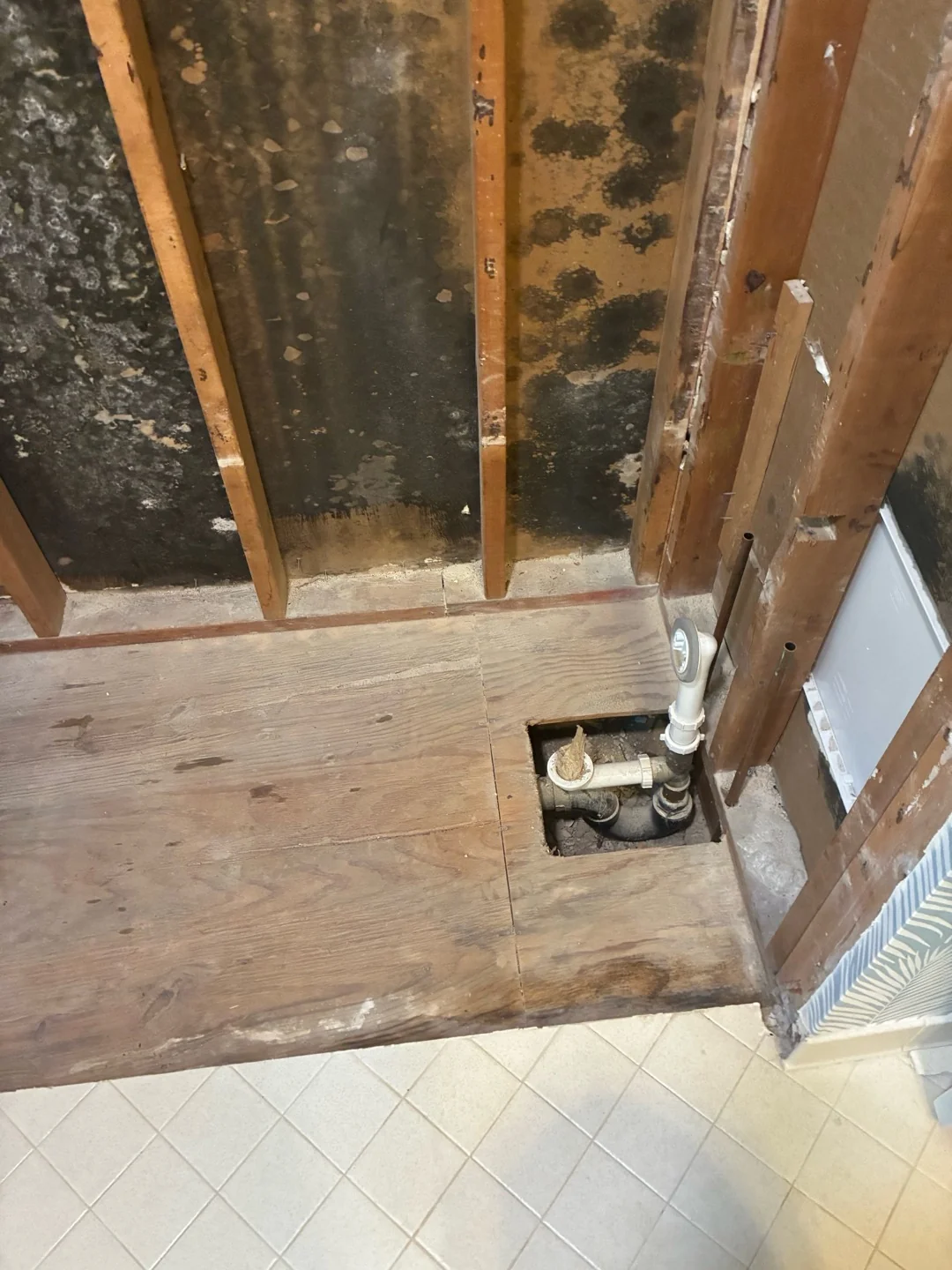
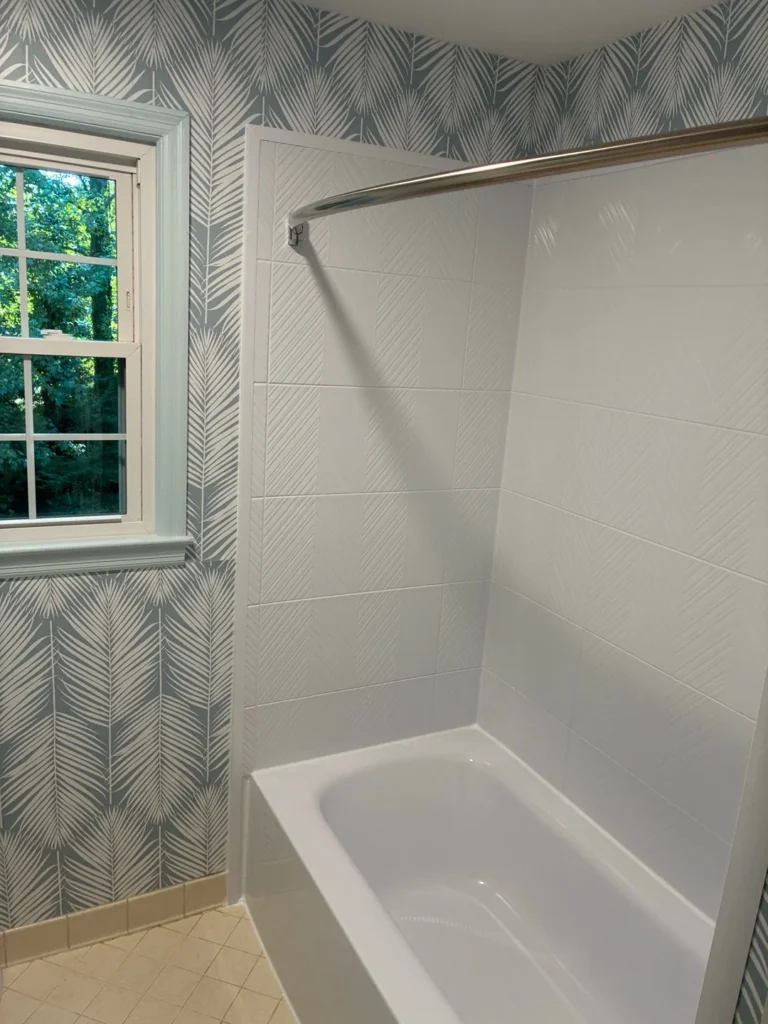
That’s why the photo above matters. Before demo, it was an ordinary bathroom with a white tub and white tile. Once the old tub came out, you could see dark staining across the wall behind it. Nothing on the bathroom side gave it away.
The EPA’s guide to mold and moisture says it simply: the key to controlling mold is controlling moisture. Behind a tub, that means fixing the leak and replacing the wood that got wet. A new surface over a wet wall just hides the problem.
What usually happens when a contractor finds rot behind a tub?
In most of the remodeling industry, it means a change order. The contract covers the work they could see, and anything they find behind the wall gets priced separately once it’s open. Sometimes that’s fair. Nobody can see through a wall, and some contractors truly can’t price a repair until they know how far it goes.
But it puts you in a tough spot. Aaron described it this way:
“Almost every project you get into, you tear something out and you find something else. That means more money… Nobody wants to pay for anything and then get halfway through the project, and you’re kind of at a rock and a hard place, saying it’s more money or the job’s over.”
Aaron Bishop · Operations Manager, Columbia and Augusta
Your bathroom is already torn apart at that point, so you don’t have much leverage. That’s why the time to ask about hidden damage is before you sign. After demo is too late.
What does Bath Fitter Fam do when we find rot behind your tub?
We fix it. If the old tub comes out and there’s rot or water damage in the wet area, replacing the damaged subfloor and framing is part of the job. It’s already in your price, so there’s no change order for it.
“Here at Bath Fitter, we don’t do that to anybody. We take care of it and make it right.”
Aaron Bishop · Operations Manager, Columbia and Augusta
There’s a practical reason we can do that. Bath Fitter makes the tub, base and walls we install, and our own employees do the demo and the install. The person who finds the rotten subfloor is the same person who replaces it, and we’ve seen enough old bathrooms to know it comes with the territory. There’s no subcontractor to send back to the office for a new price.
A repair can add time. Once in a while, a job we planned for one day runs into a second day because of what we find. You’ll know what we found and what we did about it.
One Tri-Cities homeowner’s project turned into more than a swap:
“My Bath Fitter installation went smoothly and without any hassle! Barry, our installer, was a pleasure to work with and very flexible. The installation included a complete demolition and reinstall of our plumbing, floor drain and shower.”
RuthS · Tri-Cities market · Bath Fitter customer review
When is the damage bigger than a bathroom job?
Here’s the honest limit. We fix what’s in the wet area. When the problem goes well beyond the tub, it needs a different specialist first.
That’s rare. Aaron counts just two jobs in the past two years where the floor joists themselves needed repair. But it does happen, and so do bigger structural problems. Kell Chapman, who runs our installs across the Upstate and Western North Carolina, doesn’t sugarcoat it:
“If you know you’ve had serious issues in the home for a while, and you’re not at that stage yet, we can’t help those people. You’ve got to address foundation issues first… And then when it’s ready, our time to shine is once that stuff gets taken care of.”
Kell Chapman · Operations Manager, Upstate SC and Western NC
The same goes for plumbing problems outside the bathroom. If your main line keeps backing up, a plumber needs to fix that before anyone puts in a new tub or shower. We’ll tell you that at the consultation instead of starting a job we can’t finish well. And when the house is ready, we’re glad to come back. Our one-day remodel guide covers the other things that can stretch a job.
Does homeowners insurance cover rot behind a tub?
Sometimes. Many homeowners policies cover water damage that’s sudden and accidental, like a supply line that bursts. Many exclude damage from a slow leak or wear over time, which is how most rot behind a tub happens. Every policy is different, so read yours and call your agent before you assume either way. We’re not insurance experts, and your agent is the right person for that question.
What should you ask any contractor about hidden damage?
Put these questions to every company you’re considering. We’ve filled in our answers.
| Ask this | Why it matters | Our answer |
|---|---|---|
| If you find rot when the old tub comes out, is the repair in my price? | This is where surprise change orders come from | Yes, for damage in the wet area |
| Who does the repair? | A sub called in mid-job can mean delays and a new bill | Our own team |
| Where does your repair stop? | Every company has a limit. You want to know it up front | The wet area. Foundation and main-line plumbing need a specialist first |
| Will you show me what you find? | You should see the damage before it gets covered up | Yes. Ask your installer, and we’ll walk you through it |
If you’re comparing quotes, our cost guide covers the other hidden costs worth asking about.
What should you do if you think there’s damage behind your tub?
Don’t wait on it. Keep water off the problem area as best you can, take a few photos, and have someone look at it. If you’re already thinking about a new tub or shower, the best time to deal with hidden damage is while the old one is coming out anyway.
Every Bath Fitter tub and shower comes with a lifetime warranty, and our guide to how our warranty works explains what happens when you call. You can find your local team on our contact page, get an Instant Estimate in a few minutes, or see our published pricing.
Water damage only moves in one direction. The sooner somebody looks, the smaller the fix.
Sources
Frequently asked questions
Can you tell if there’s rot under a bathtub without removing it?
Sometimes. A soft or spongy floor in front of the tub, loose floor tiles, a stain on the ceiling below or a musty smell are good clues. But fiberglass units and tile surrounds can hide damage completely, so the only sure way to know is when the old tub comes out.
How much does it cost to fix rot under a tub?
With Bath Fitter Fam, repairing rot or water damage we find in the wet area is included in your price, so there’s no change order. With other contractors it varies a lot with how far the damage goes, so ask before you sign whether hidden damage is in the quote or billed separately.
Is a soft floor in front of the tub dangerous?
It can be. A soft spot means the subfloor has been wet long enough to weaken, and it usually gets worse over time. Keep water off the area, be careful stepping in and out, and have it looked at soon.
Can you put a tub liner over a tub with water damage underneath?
A liner relies on the old tub and the floor for support, so it isn’t the right fix if the tub moves or the floor is soft. In that case the tub should come out so the damage can be repaired. Your consultant checks for this before recommending a liner.
Will finding rot delay my installation?
Sometimes. Most repairs fit into the install, but once in a while a job planned for one day runs into a second day because of what we find. We’ll show you what we found and what we did about it.
This guide applies to: Bath Fitter Augusta, Bath Fitter Columbia, Bath Fitter Little Rock, Bath Fitter Memphis, Bath Fitter Oklahoma City, Bath Fitter Tri Cities, Bath Fitter Upstate SC/Western NC.