
Summary
- “Acrylic” covers a family of engineered plastics. Bath Fitter’s is a proprietary blend with PVC and ABS, made to flex a little instead of cracking.
- What people love: no grout to scrub, mold has a harder time taking hold, it’s warmer than tile, it comes in 12 tile-look patterns, and installs can take as little as one day.
- What to know going in: abrasive scrubbers scratch it, harsh cleaners can dull the finish, and real stone or a one-of-a-kind tile layout is still tile’s territory.
- Cost: a typical Bath Fitter tub-to-shower conversion runs $8,500–$15,000. The shower part of a full mid-range remodel runs about $16,000 to $19,000.
- It’s probably not for you if you want real tile or stone specifically, your plumbing needs major work first, or you just need the cheapest quick refresh.
In this guide
Homeowners across our seven markets ask us some version of this every week: “Is acrylic just a fancy word for plastic?” Fair question. The Mullikin family has been running Bath Fitter offices since 2003, from the Upstate to Oklahoma City, and we’ve put acrylic into thousands of bathrooms. We’ve also told plenty of people it wasn’t the right call for them. Sometimes tile is the better answer. Sometimes a quick reglaze is. Sometimes the plumbing has to be fixed before anybody touches the walls.
So maybe you’ve gotten a quote and wondered if you’re paying for a glorified shower liner. Or a friend told you acrylic turns yellow and cracks in five years, and now you’re not sure who to believe.
We get it. Just about everybody has a contractor horror story, and this industry doesn’t exactly have a reputation for straight answers. So here’s ours, including the parts that don’t make acrylic look good.
Below, we’ll cover what acrylic actually is, where it beats tile and where it doesn’t, the honest downsides, how long it lasts, what it costs next to the alternatives, and who should skip it entirely.
What is an acrylic shower wall, exactly?
Acrylic is an engineered plastic that’s been around since 1933, when Rohm and Haas first produced it. It’s the same family of material used in airplane windows, which tells you something about how it handles impact. In bathrooms, sheets get heated, vacuum-formed over a mold, and reinforced from behind.
Here’s where people get confused. Very few “acrylic” bath products are one pure material. Most are layered or blended, and the recipe varies a lot from one manufacturer to the next. So the word on the quote tells you less than you’d think. What you actually want to know:
- What’s the full material, and who makes it? Pure acrylic is hard but can be brittle. Blends trade a little hardness for toughness.
- How thick is it, and how is it supported? Thin material over a bad substrate flexes every time someone leans on it. That’s where cracks come from.
- Is it actually fiberglass? Gel-coated fiberglass gets lumped in with acrylic all the time, and it’s a different animal. John Barnett, one of our sales trainers with 16 years in this business, puts it plainly: fiberglass has a shelf life.
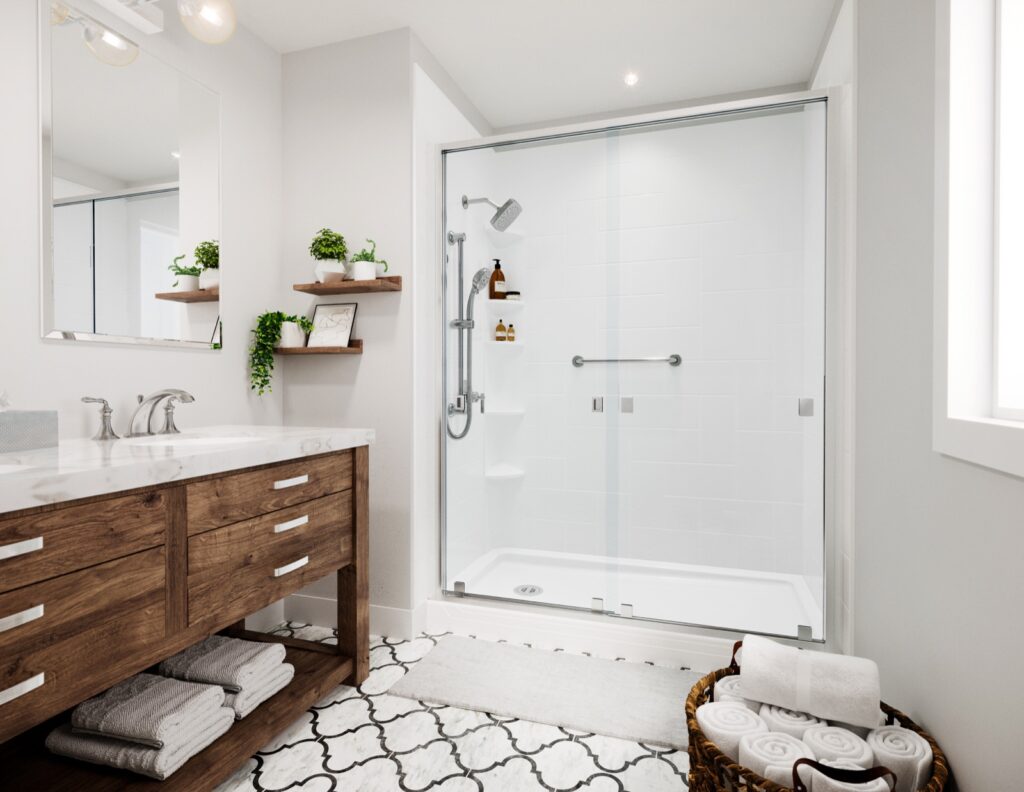
Here’s ours, straight. Bath Fitter manufactures the systems our local crews install, using a proprietary acrylic blend that includes PVC and ABS. The point of the blend is flexibility. It can give a little under weight or impact and come back, where a more brittle sheet might crack. Each tub and wall is custom-fit to your existing bathroom, and the wall goes in as one piece. That’s the one-piece wall you’ll hear us talk about: no grout lines and no tile seams for water to sneak into.
So how does one piece get around a corner? Most acrylic wall kits come as two or three flat panels, joined in the corners with a bead of silicone, and those corner seams are a common place for water to work its way behind the wall over time. Ours is a single sheet with an ABS backing, heated and bent at the corners, so there’s no corner seam at all. People sometimes ask whether bending weakens the corner. Once it’s bent and installed correctly, that isn’t something our operations managers run into. Acrylic also flexes slightly as your house expands and contracts, where rigid fiberglass is more likely to crack.
What are the real advantages of acrylic over tile?
No grout. This is the big one. Tile itself is waterproof. Grout isn’t. It’s porous, it needs resealing, and it’s where mold and discoloration show up first. A one-piece acrylic wall doesn’t have grout lines, so that whole chore goes away. The sealed joints around fixtures still need normal care, and we’ll show you how.
Mold has a harder time. Because acrylic is non-porous, water sits on it instead of soaking in, and mold has a harder time getting a foothold. That matters in the South, where the bathroom rarely dries out in July. Notice we said “harder time.” Soap scum and mildew can still build up on any shower surface if nobody wipes it down. The difference is that on acrylic it wipes off, and on grout it digs in. The EPA’s guidance on mold makes the same point: control the moisture and you control the mold.
“Our old shower was the typical shower installed in homes built in the late 2000s – small, prone to mildew, very limited shelf space… most importantly, it is very easy to keep clean! Our bathroom’s floor plan is not symmetrical. Bath Fitter was able to work around the unique layout.”
Kyle L. · Upstate SC/Western NC market · Google review, 2023
It’s warmer. Acrylic doesn’t pull heat out of your skin the way stone or ceramic tile does. It’s a small thing until it’s 6 a.m. in January in Asheville.
Faster installs. A tiled shower involves demo, backer board, waterproofing, setting tile, curing, grouting, and sealing. That’s often a week or more of a torn-up bathroom. Our installations can take as little as one day, although some projects take longer, usually when we find something behind the old wall that needs fixing first.
“John, the installer, was on time and finished about 530 the same afternoon… even though there was extra work to get floor level and walls square.”
Brent G. · Upstate SC/Western NC market · Google review, 2025
That’s the part we like most about Brent’s review. The extra work got done instead of covered up.
It looks like tile without acting like tile. This is the one people don’t expect. Old-school acrylic meant a plain white shell. Today our walls come in 12 tile-look patterns, molded right into the one-piece wall: Genova, Lucca, Milano, Napoli, Padova, Palermo, Rimini, Roma, Savona, Sorrento, Torino, and Verona. You’ll find linear subway styles, a herringbone-style pattern (Lucca, new in 2025), a stone-textured finish, small square grids, large-format tile looks, and designs with a decorative border band. From across the room, most people read it as tile. Up close, there’s still no grout to scrub. Your design consultant can bring samples to your house so you can see them in your own bathroom light.
Less skill-dependent. Tile is only as good as the person who set it. As John puts it, with tile the cost and quality swing on who’s installing it, not the material. A factory-made wall takes a lot of that variable out.
What are the downsides of acrylic showers?
Here’s the part most acrylic companies skip.
It can scratch. Acrylic is softer than porcelain or glazed tile. Scouring powders, green scrubby pads, and steel wool will dull or scratch it. The fix is easy: put the scrubby pad away. A soft cloth does the job.
The cleaner you use matters. Harsh chemicals can dull or damage the finish, so Bath Fitter keeps a list of more than 100 approved cleaners that are safe on acrylic. Our team’s first pick is Clorox Clean-Up with bleach, for the walls and the silicone around the edges. The rule that matters most is to rinse any cleaner off right away. Skip straight bleach soaks and stiff scrub brushes, which are one of the few ways to actually scratch acrylic. A weekly spray, a wipe with a soft cloth and a rinse is plenty. We leave you a squeegee, too. Your installer is happy to walk you through it before they head out.
It’s a curated set of designs, not unlimited. Twelve tile-look patterns cover what most people are after, from classic subway to herringbone to large-format stone looks. But it’s still twelve. If you’ve picked out a specific designer tile, want real marble veining, or want a one-off layout nobody else has, that’s what a tile setter is for.
A one-piece wall has a height limit. A single bent sheet can only be so tall. Our standard wall plus the base reaches about 96 inches, which covers most homes, and a lot of the time we’re buttoned right up to the crown molding. If your ceiling is taller than that, we add a sealed upper acrylic section, with the seam up near the ceiling, well above where the water hits. Your design consultant will measure and tell you at the consultation.
Cheap acrylic cracks. When you hear acrylic horror stories, it’s almost always thin, brittle material or a tub that wasn’t fitted and supported properly. Every time someone steps in, it flexes against nothing, and eventually it fails. That’s a material and installation problem more than an acrylic problem. But it’s real, and it’s why you should ask the three questions above.
What’s behind the wall still matters. Acrylic doesn’t fix rot, a leaking valve, or a soft subfloor. A good installer inspects for that and deals with it. A bad one covers it up. It’s one of the reasons we sometimes walk away from a job when the plumbing can’t be brought up to standard.
It isn’t “maintenance-free.” You’ll see that phrase all over the internet, including on older pages of our own websites. It’s low-maintenance. You still clean it. You just don’t regrout it.
How long does an acrylic shower last?
Short answer: a long time, if it’s good material and it’s put in right.
Acrylic is the same family of material used for football helmet shells, aquarium walls and hockey rink boards, so it’s used to taking a beating. And in the 23 years our family has been doing this, William Mullikin says he’s never seen one of our acrylic showers fade.
Quality acrylic, installed correctly, is built to last for decades. But the best clue isn’t a lifespan number. It’s the warranty, and whether the people behind it still pick up the phone ten years from now.
Every Bath Fitter acrylic tub and wall comes with a lifetime warranty, and we take it seriously. If something ever doesn’t look or feel right, call us. We’d much rather hear about it than have you live with it.
Here’s what that looks like in real life, including a part a lot of companies would leave out of their own blog. SaVetra didn’t even buy her shower from us. The previous owners of her house did. When her shower doors started sticking after years of daily use, she called us expecting a repair bill.
“Bath fitter let me know that everything was taken care of by the lifetime warranty. Once the technician arrived he repaired the issue and made arrangements for me to get a brand new shower installed due small cracks in the corner he noticed during the door repair.”
SaVetra · Upstate SC/Western NC market · Google review, 2025
Yes, her shower had developed small cracks in a corner. Acrylic isn’t magic. But our technician spotted it while he was there for something else, and about three weeks later, she had a brand-new shower. She didn’t have to fight for it. That’s exactly how a warranty should feel.
How much does an acrylic shower cost compared to tile or reglazing?
| Option | Typical cost | How long it takes | Maintenance | Best for |
|---|---|---|---|---|
| Reglazing / refinishing | Usually the lowest-cost option; get a written quote | About a day, plus cure time | A coating that wears over time and can peel | A tight budget or a quick refresh before listing |
| DIY acrylic or fiberglass kit | Big-box store materials, plus your weekend | A weekend or more, depending on skill | Depends on the kit and the install | Handy homeowners with sound walls and plumbing |
| Bath Fitter acrylic (one-piece wall) | $8,500–$15,000 for a typical tub-to-shower conversion; about 70% of customers land in the middle | As little as one day; some projects take longer | Wipe down with an approved cleaner; no grout | People who want a custom-fit system, installed fast, with a lifetime warranty |
| Custom tile (as part of a full remodel) | About $16,000 to $19,000 for the shower area of a roughly $26,000 national mid-range remodel | Often one to three weeks | Grout needs cleaning and periodic resealing | People who want real stone or a one-of-a-kind layout and are renovating the whole room |
A few notes on reading that table. The tile figure is the wet-area share of a full remodel, since that’s how most tile showers get priced. Our $8,500 job and our $15,000 job use the same material and the same wall system. What moves the price is what you pick: glass door, hardware finish, seats, shelving. The full breakdown is in our Bath Fitter cost guide.
Is acrylic safer for aging in place?
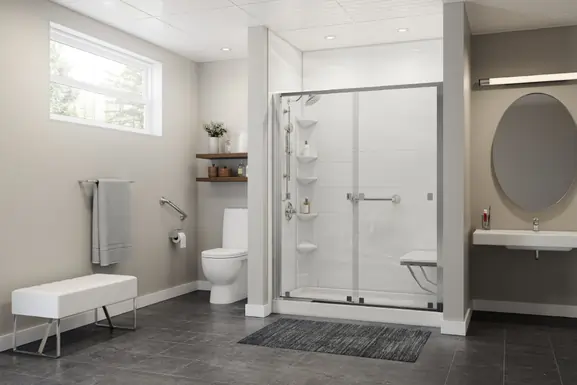
It can be, mostly because of what it lets you add. Converting a tub to a low-threshold acrylic shower base means no more lifting your legs over a tub wall, and grab bars and seats can go in as part of the install. For a lot of the families we work with, that’s the whole reason they called, and it’s our favorite kind of project. Getting someone back to showering on their own, safely, is a big deal. See Tub to Shower Conversion for how that works.
Who should not choose an acrylic shower?
We’d rather lose the job than have you regret the project, so here’s the short list:
- You want real tile or natural stone, specifically. If it’s the look you’re after, see our 12 tile-look patterns first. If it’s the material itself, hire a good tile contractor. We don’t set tile.
- You’re listing the house in 60 days and the shower works fine. Cheaper cosmetic work usually returns more per dollar.
- Your plumbing needs major work. Get a licensed plumber first. We’ll happily come back after.
- You want the cheapest possible option. That’s usually reglazing. Just know what you’re buying.
So, is acrylic worth it?
For most people who want a shower that’s easy to keep clean, goes in fast, and has a real warranty behind it, yes. For people set on real stone or a one-of-a-kind tile layout, or who just need the cheapest quick fix, probably not, and that’s fine.
If you want to see what yours would cost, get an Instant Estimate, or we can come out for a free in-home consultation and give you an exact price. No fake discounts, no “let me call my manager” routine. Just a straight number and plenty of time for your questions.
Whatever you decide, make sure whoever you hire does what they say they’re going to do.
We’d love to help you figure it out. See our published pricing or get an Instant Estimate whenever you’re ready.
Sources
Frequently asked questions
Does acrylic turn yellow over time?
Good acrylic holds its color and shine for years with normal care. Yellowing usually shows up on older fiberglass, cheap coated products, or surfaces cleaned with harsh chemicals.
What cleaners should I use on an acrylic shower?
A soft cloth and a cleaner from Bath Fitter's approved list. Skip scouring powder, steel wool, and green scrub pads on any acrylic.
Can Bath Fitter install over my existing tile?
In a lot of bathrooms, yes. We'll take a look at what's underneath first. If the walls or plumbing aren't in good shape, we'll tell you straight.
Does the Bath Fitter warranty transfer if I sell my house?
It can, which is a nice bonus if you ever sell. Bath Fitter's lifetime warranty page has the full details.
Do I need a permit for an acrylic tub-to-shower conversion?
It depends on where you live. Rules vary by city and county, and your design consultant will let you know if your project needs one.
This guide applies to: Bath Fitter Augusta, Bath Fitter Columbia, Bath Fitter Little Rock, Bath Fitter Memphis, Bath Fitter Oklahoma City, Bath Fitter Tri Cities, Bath Fitter Upstate SC/Western NC.